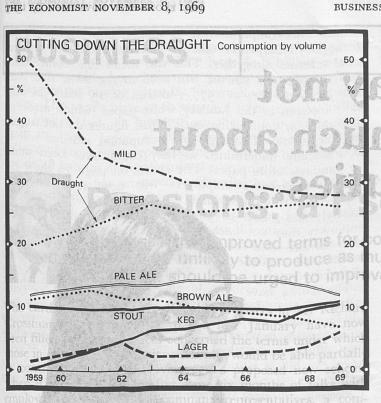
Lager's market share rose rapidly as brewers spent money on production capacity and advertising (Source: The Economist)
At the end of November 1969, the British Labour government generously allowed a price increase of ‘not more than 2d a pint’ to the brewing industry. There was little rejoicing among brewers; first because they had asked for double and second because the 2d increase was split two to one in favour of the retailers.
The Prices and Incomes Board was the main instrument of the government’s prices and incomes policy to rein-in inflation, but it was also one of the factors that helped spur the growth of lager.
British brewers at the end of the sixties were growing and consolidating. By 1969 the cost of brewing and retailing a pint had risen by over 15%, according to The Economist. At the same, time while beer volumes had risen by round 1% to 2% a year, it wasn’t enough to cover the capital needs for an industry that was rationalising production, refurbishing pubs and expanding overseas.
Brewers were concentrating on cutting costs by brewing centrally, distributing nationally and backing this with massive advertising campaigns. The number of breweries in the UK had fallen from 6,200 independently owned and managed breweries to 200. But the consolidation of ownership meant that these breweries were managed by only 100 different companies.
Keg beer and lager fitted the centralisation plans of the breweries perfectly. They were both pasteurised and easier to brew than draught beer and were ideal for the new outlets, such as clubs, that didn’t have the dedicated facilities to handle hand-pulled beers. They were also ideal for canning, which was slowly replacing bottled beer.
Lager was big business
Many reasons have been given for the spectacular growth of lager during the seventies and eighties: a change in taste for post-industrial office workers who couldn’t ‘handle’ draught beers, and a series of hot summers are the most popular. They include elements of truth, but underlying them all was that lager was good business for the brewers.
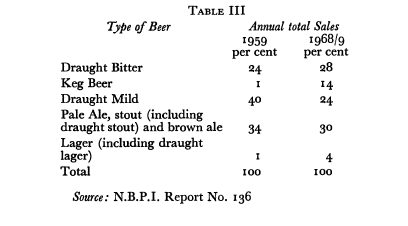
Why? Because they earned more money on lager (and keg) than on draught. During 1969, lager sales grew by 30%. Although they only took 5% of the entire market, a quick look at the Scottish market, where lager had its British stronghold, showed a 20% market share.
Prices per pint were higher than bitter by around 6d, and more was sold outside of the pubs and so the brewers were free to charge what they wanted. Add to this a slightly lower excise duty and all the benefits of modern rationalised production and it isn’t hard to see why in the few years up to the end of the decade £20 million was spent on building facilities for lager alone and £3 million was spent on advertising keg, lager and canned beers.
At the same time, the number of draught beers was reduced, with The Economist commenting darkly that by the mid-70s it would be impossible to buy draught beer.
With the resources thrown at lager and keg by breweries in search of better profits (between 1966 and 1969 profits grew by only 17% compared with 40% for the rest of industry), is it any wonder that the UK became a nation of lager drinkers?



 LAGER FRENZY!