
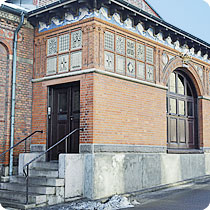
Lager brewing’s most picturesque car park

The Carlsberg Museum in Valby

The Carlsberg Museum in Valby

Last year Carlsberg shut the brewery on the ‘mount’ in Valby, Copenhagen, that was not only the company’s birthplace, but also gave rise to its name (Carls berg – Carl’s mount).

Many traditions were lost with the closure, and yesterday one of them took place for the last time ever. In one of the halls of the Carlsberg Museum, hang the portraits of Carlsberg employees with 50 years’ service. At a ceremony yesterday, the last Carlsberg employee in Valby had his portrait hung on the walls.

I saw it on the Danish local news last night and thought that it would make and interesting subject for a blog post about the disappearing industrial history of lager breweries.

Except that it has already disapeared. I looked for a press release from Carlsberg – nothing. There was also nothing on the TV site and so far nothing on any searches. It strikes me as a shame that a brewery that has been accused of throwing the baby out with the bathwater with the closure of the historic site, hasn’t done more to show that the traditions are still important.

While production has been moved from the brewy to Fredericia on the other side of Denmark, many of the brewery buildings still stand and you can wander freely between some striking examples of industrial architecture for the first time. It  is open to the public  in the space between closure and the property developers moving in, because its a car park.
Posted in Brewing history, Lager | Tagged | 1 Comment

The great taste of lager advertising

This episode was inspired by the Budweiser radio commercials current running on my favorite station. Are they telling the truth? It’s a little hard for me to believe.

With thanks to Dave Stratton at Deadpan Inc.

Added with no comment 🙂

Posted in Advertising, Brands, Lager | Tagged | Comments Off on The great taste of lager advertising

‘Thirsty Scots? No, it’ll never catch on’

'Dear Carl, thanks for the letter, but I think I'll pass. All the best, Dad.' (Pic: Carlsberg)

'Dear Carl, thanks for the letter, but I think I'll pass. All the best, Dad.' (Pic: Carlsberg)

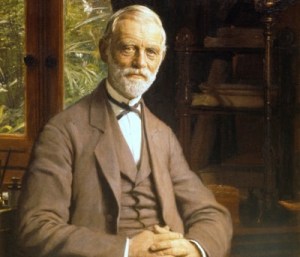
There you are at the end of the 1860s brewing away quite happily, when your son sends you a letter saying that he’s found a ready market for your beer in Scotland.

Does the thought of thousands of thirsty Scots send you rushing to the brewery foreman and tell him to stoke up the fires and get another brew on? Not if you’re JC Jacobsen, the founder of Carlsberg.

In 1868-69, his son Carl was spending time at the J.W. Younger brewery in Edinburgh as part of his four-year apprenticeship in breweries around Europe. Through his friendship with Theilemann, a Danish merchant in Leith, Carl recognised the potential of the Scottish market and encouraged his father to dispatch beer to be sold locally.

But while the elder Jacobsen did send over some of his Bavarian dark lager, he wasn’t convinced about this new fangled ‘exporting’. He believed that production  had a natural limit and brewing more to satisfy overseas markets would result in a drop in beer quality. He had little faith in the commercial value of exports, seeing them more as an experiment than a viable commercial venture. In a letter in 1869, Jacobsen wrote that he was sending a few crates of Bavarian beer left over from a batch brewed for Theilemann to the English East Indian ports.

‘I do not expect that Bavarian beer will be a sought-after export article in India, but it is always interesting to discover whether it can withstand the journey,’ he noted.

In fact, Jacobsen prefered to emulate the British brewers of the time and brew ale. He actually built an ale brewery for his son to run in Copenhagen and had Carl send several barrels of Bass to Copenhagen – complete with labels – so he could taste the beer from authentic bottles.

He had no great love of English beer, though. He admitted in a letter in 1855 that his stay in London was made difficult by a ‘lack of decent beer to drink’. But he was a great admirer of English methods of rational production and the advantages gained from the resulting beer’s long shelf-life.

But the sale of ale didn’t go down too well in Copenhagen and the brewery was converted for brewing lager. On the other hand exports, despite Jacobsen’s reluctance rose year by year. By spring 1870, Carlsberg had orders of 2,300 barrels ready to send to Scotland and England and in 1885 sales had reached around 10,000 hectolitres.

Posted in Brewing history | Tagged , , | Comments Off on ‘Thirsty Scots? No, it’ll never catch on’